
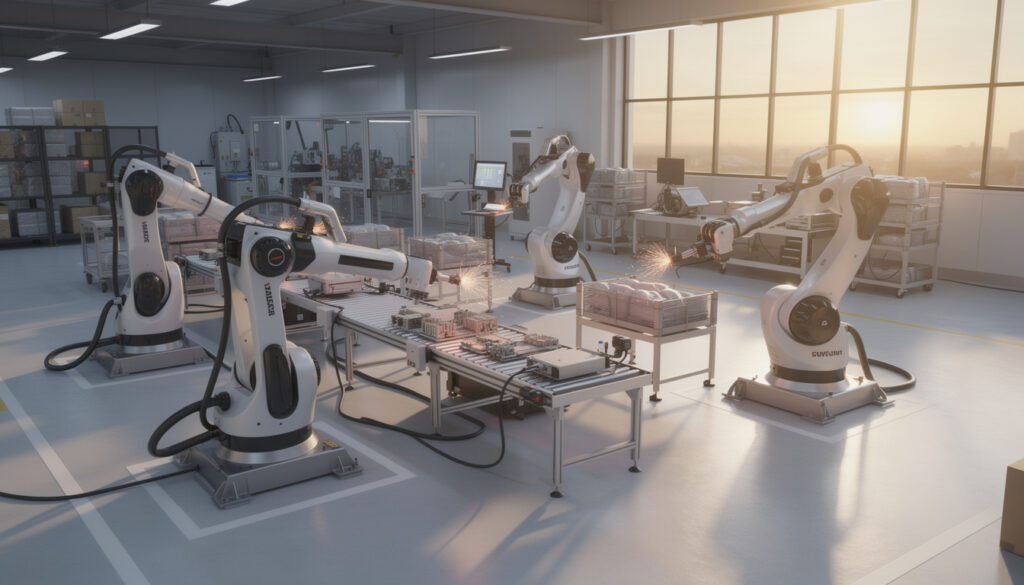
What is Robotics in Manufacturing?
Industrial robotics involves programmable robotic systems that perform manufacturing tasks such as material handling, processing, assembly, and quality inspection with consistent speed and precision. These systems integrate robots with specialized tooling, sensors, and software to create repeatable workflows that operate reliably across production shifts. Manufacturing automation through robotics combines mechanical components with control systems to execute predefined sequences without human intervention.
Robotic systems in manufacturing environments typically include the robot arm, end-of-arm tooling, safety equipment, control software, and peripheral devices such as conveyors or vision systems. Single-station automation might involve one robot performing a specific task like machine loading, while multi-station robotic cells can handle complete assembly sequences. Integration with existing production data systems allows manufacturers to monitor performance, track quality metrics, and optimize cycle times based on real operational data.
How are Robots Used in Manufacturing Today?
Production line robots perform tasks that require repetitive motion, operate in hazardous environments, or demand precise cycle times that human operators cannot consistently maintain. Industrial robotics applications span from simple pick-and-place operations to complex multi-step processes involving welding, painting, assembly, and inspection. These systems excel in environments where consistency, speed, and safety are priorities.
Material Handling and Transfer
Robots handle materials by loading and unloading machines, transferring parts between workstations, and organizing components for downstream processes. These applications typically involve grippers or vacuum systems designed for specific part geometries. Material handling robots reduce manual lifting injuries while maintaining consistent cycle times regardless of shift changes or operator availability.
Processing Operations
Tool-on-part applications involve robots manipulating welding torches, grinding wheels, spray guns, or cutting tools onto workpieces. These operations require precise path control and consistent tool positioning to achieve quality specifications. Robotic welding provides repeatable weld profiles, while automated painting ensures uniform coating thickness and reduces material waste.
Assembly and Inspection Tasks
Precision assembly operations use robots to position components with repeatability measured in fractions of millimeters. Vision systems integrated with robotic cells enable quality inspection by detecting dimensional variations, surface defects, or missing components. These applications combine speed with accuracy to maintain production flow while ensuring quality standards.
Understanding Industrial Robots and Robotic Cells
What is an Industrial Robot?
An industrial robot functions as an automated, programmable machine with multiple axes of motion specifically designed for manufacturing tasks. Robotic systems are typically deployed with end-of-arm tooling and safety equipment to create complete automation solutions. Selection criteria include payload capacity, reach envelope, speed capabilities, positional repeatability, and environmental ratings for temperature, humidity, and contamination resistance.
Modern industrial robotics incorporates servo motors, encoders, and control algorithms that enable precise positioning and path following. These machines operate according to programmed instructions that define movement sequences, tool operations, and safety protocols. Integration with sensors provides feedback for adaptive behavior based on part variations or process conditions.
What is a Robotic Cell in Manufacturing?
A robotic cell defines a work area where robots, tooling, safety equipment, and peripheral devices integrate to automate specific manufacturing processes. Manufacturing automation through robotic cells ranges from single-robot stations with basic fixturing to complex multi-robot systems incorporating conveyors, vision inspection, and quality monitoring. Companies like Assatec provide integrated solutions for various industrial automation needs.
Robotic cells are engineered around takt time requirements, part presentation methods, and quality specifications. Design considerations include material flow, operator access for changeovers, maintenance accessibility, and expansion capability. Cell layouts accommodate the specific geometry and handling requirements of target parts while maintaining safety and efficiency.
Typical robotic cell components include the robot manipulator, end-effectors or grippers, part fixtures, safety guarding, control panels, and peripheral equipment such as conveyors or inspection systems. Common cell layouts feature in-line configurations for continuous flow, U-shaped arrangements for operator access, rotary tables for multi-station processing, and dual-station designs that enable simultaneous loading and processing.
Integrated robotic cells outperform standalone robots in production environments because they address the complete automation requirement rather than just the robot motion. Standalone robots require additional engineering for part presentation, safety systems, and process integration, while designed cells provide these elements as coordinated systems optimized for specific applications.
What are the Benefits and Limitations of Robotics?
What are the Benefits of Robotics in Manufacturing?
Robotic systems improve manufacturing throughput, product consistency, workplace safety, and production data visibility while reducing scrap rates and stabilizing cycle times. Manufacturing automation through robotics provides consistent performance that eliminates variations caused by operator fatigue, skill differences, or shift changes. This consistency translates to improved first-pass yield and reduced rework requirements.
Robots operate continuously across multiple shifts with predictable performance characteristics. They can work in environments that present safety hazards to human operators, such as high-temperature areas, chemical exposure zones, or locations with heavy machinery. Data collection capabilities enable real-time monitoring of cycle times, quality metrics, and equipment utilization.
What are the Disadvantages or Limitations of Robots in Manufacturing?
Industrial robotics requires substantial upfront investment, complex integration engineering, and ongoing maintenance by skilled technicians. Process variability challenges arise when robots encounter parts or conditions outside their programmed parameters. Successful automation demands stable upstream processes, consistent part quality, and reliable fixturing systems.
Automation can expose weaknesses in existing manufacturing processes, such as inconsistent part dimensions, inadequate fixturing, or unstable material flow. Robotic systems increase downtime risk when spare parts, training programs, and technical support plans are insufficient. Integration complexity often exceeds initial estimates, particularly when interfacing with existing equipment or quality systems.
How Much Do Robotic Systems Cost and How is ROI Calculated?
How Much Does a Manufacturing Robot Cost?
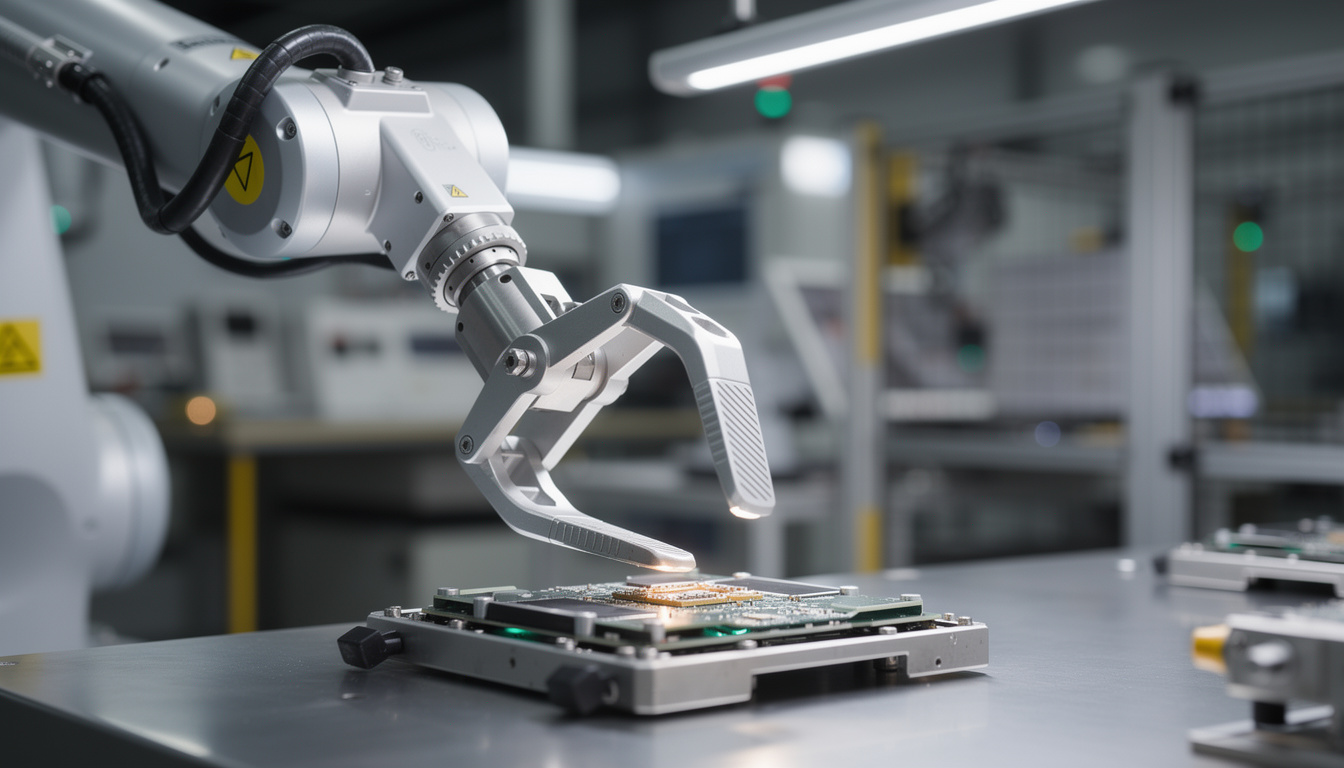
The robot arm represents only a portion of total system cost, with significant expenses including end-of-arm tooling, safety hardware, integration engineering, programming, and commissioning activities. Industrial robotics projects typically involve grippers or specialized tooling, part fixtures, conveyors, vision systems, safety guarding, and control system integration. A robotic cell installation often costs three to five times the robot hardware price.
Cost distribution shows robot hardware typically accounting for 20-30% of total project expense, with tooling and fixtures representing 25-35%, safety and peripherals adding 20-30%, and engineering integration comprising 15-25%. Simple material handling applications might require lower integration costs, while complex processing operations with vision inspection and quality monitoring demand extensive engineering support.
Budget ranges vary significantly based on application complexity. Basic pick-and-place operations might require 50,000-100,000 dollars total investment, while sophisticated welding or assembly cells can exceed 300,000 dollars. Multi-robot production lines with integrated quality systems often require investments exceeding 500,000 dollars.
How Do Manufacturers Calculate ROI for Robotic Systems?
Manufacturing automation ROI calculation compares total installed cost against annual savings from labor reallocation, throughput increases, scrap reduction, and downtime elimination. Financial analysis includes realistic assumptions about overall equipment effectiveness, maintenance costs, and changeover impacts. Payback periods typically range from 1-3 years for well-designed applications.
ROI calculations include labor savings from reduced staffing requirements, overtime elimination, and reallocation of workers to higher-value tasks. Quality improvements reduce scrap costs and rework expenses. Throughput gains from consistent cycle times and reduced changeover requirements increase revenue potential. Safety improvements reduce insurance costs and worker compensation claims.
Common ROI calculation errors include overstating cycle time improvements, underestimating integration complexity, and ignoring maintenance requirements. Realistic analysis accounts for learning curve effects, spare parts inventory, and ongoing training costs. Successful projects typically achieve 20-40% annual returns on investment when properly implemented and maintained.
| Concept | What it is | Best for | Typical Scope | Key Constraint |
|---|---|---|---|---|
| Robot (standalone) | A programmable multi-axis machine | Simple handling or a single task | One station | Usually needs tooling + safety + part presentation to be productive |
| Robotic cell | Integrated work area with robot(s), tooling, safety, peripherals | Repeatable processes with defined inputs/outputs | One process or a small set of steps | Integration quality determines uptime and ROI |
| Production line automation | Multiple linked stations forming a flow | High-volume, synchronized production | End-to-end or multi-stage | Balancing stations and managing line downtime propagation |
Implementation, Safety, and Future Trends in Manufacturing Robotics
How is Robot Safety Handled in Manufacturing Environments?
Robot safety management involves risk assessment, physical safeguarding, safe operating modes, and validated safety functions designed for specific robotic cell applications. Industrial robotics safety design considers robot speed, payload capacity, tooling hazards, and frequency of human interaction. Safety implementations follow established standards such as ISO 10218 for industrial robot safety requirements.
Risk assessment identifies potential hazards including crushing, cutting, impact, and entanglement risks based on robot motion, tooling, and workspace layout. Severity analysis considers injury potential, exposure frequency, and mitigation effectiveness. Safeguarding options include physical barriers, safety scanners, light curtains, and interlock systems that prevent unsafe access during robot operation.
Collaborative operation enables human-robot interaction under controlled conditions with reduced speed, limited force, and monitored separation distances. However, collaborative modes may not suit all applications, particularly those involving sharp tools, hot materials, or high-speed operations. Traditional safeguarded cells often provide better throughput and safety for many manufacturing applications.
What Maintenance and Skills are Required to Keep Robots Running?
Production line robot maintenance requires preventive service schedules, spare parts inventory, and trained personnel for troubleshooting mechanical, electrical, and programming issues. Maintenance plans include regular lubrication, calibration verification, wear component replacement, and safety system validation. Backup procedures ensure rapid recovery from equipment failures.
Staff training covers basic robot operation, routine maintenance tasks, and first-level troubleshooting procedures. Advanced support requires specialists in robot programming, control systems, and mechanical repairs. Escalation paths connect plant personnel with equipment suppliers for complex technical issues. Training reduces downtime duration and improves changeover reliability between different production runs.
What is the Future of Robotics in Manufacturing?
Manufacturing automation advances toward more flexible systems incorporating improved vision capabilities, simplified programming interfaces, enhanced connectivity, and data-driven process adaptation. Robotic systems increasingly use artificial intelligence for vision recognition, path planning, and adaptive control based on real-time feedback. According to the International Federation of Robotics, global robot installations continue growing as manufacturers seek competitive advantages through automation.
Technology trends include faster changeover capabilities through modular tooling, digital twin simulation for virtual commissioning, and predictive maintenance using sensor data analysis. Modular robotic cell design enables reconfiguration for different products without complete system redesign. Integration with enterprise systems provides production visibility and enables data-driven optimization of manufacturing operations.
Despite technological advances, practical implementation focuses on reliability, safety, and measurable return on investment. Future developments emphasize reducing integration complexity, improving system flexibility, and enabling faster deployment of automation solutions across diverse manufacturing applications.
Will Robots Replace Manufacturing Jobs?
Manufacturing automation typically shifts employment from repetitive or hazardous tasks toward roles in equipment setup, quality control, maintenance, programming, and production supervision. Industrial robotics implementation often coincides with workforce reskilling programs that prepare employees for technical positions supporting automated systems. Job impact varies based on facility operating models and automation scope.
Workforce planning around automation includes standard work updates, training programs, and career development paths for existing employees. Many manufacturers implement robotics to address labor shortages rather than reduce headcount. Safety improvements through automation remove workers from dangerous environments while creating opportunities in equipment operation and maintenance.
Automation adoption frequently responds to labor availability constraints and safety requirements rather than pure cost reduction. Facilities with difficulty recruiting and retaining production workers often use robotics to stabilize operations. The integration of advanced control systems supports this transition by providing sophisticated monitoring and adjustment capabilities.
Robotics in manufacturing succeeds through systematic integration of hardware, software, safety systems, and process design rather than simply installing robot equipment. Best outcomes result from selecting stable applications, designing robust part presentation systems, planning thoroughly for safety and maintenance requirements, and measuring ROI with realistic assumptions about integration complexity and operational requirements. Industrial robotics provides transformative potential for manufacturing efficiency and competitive advantage when implemented as complete automation solutions rather than standalone robot installations.
Assatec Robotics was founded in 1997 and specializes in developing custom robotic cells and automation systems. The company serves as a leading Fanuc systems integrator.
What is the difference between an industrial robot and a robotic cell?
An industrial robot is a programmable machine with multiple axes of motion designed for manufacturing tasks. A robotic cell is an integrated work area that combines one or more robots with tooling, safety equipment, and peripheral devices to automate complete processes. The cell includes all components needed for production, while a standalone robot requires additional systems for practical manufacturing use.
How long does it typically take to implement a robotic system?
Implementation timelines vary from 3-6 months for simple applications to 12-18 months for complex multi-robot systems. Factors affecting duration include application complexity, integration requirements, safety validation, programming, testing, and operator training. Proper planning and experienced integration partners reduce implementation time and risk.
What types of parts are best suited for robotic automation?
Parts with consistent geometry, predictable placement, and stable quality characteristics work best with robotic systems. Applications requiring repetitive handling, precise positioning, or operation in hazardous environments benefit most from automation. Parts with extreme variation, delicate materials requiring human judgment, or complex assembly requiring dexterity may not suit current robotic capabilities.
How do manufacturers justify the cost of robotic automation?
ROI justification combines labor savings, quality improvements, throughput increases, and safety benefits. Typical payback periods range from 1-3 years based on application complexity and operational improvements. Successful projects consider total cost of ownership including maintenance, training, and spare parts rather than just initial investment costs.
More Online Resources: https://assatec.co.il/